
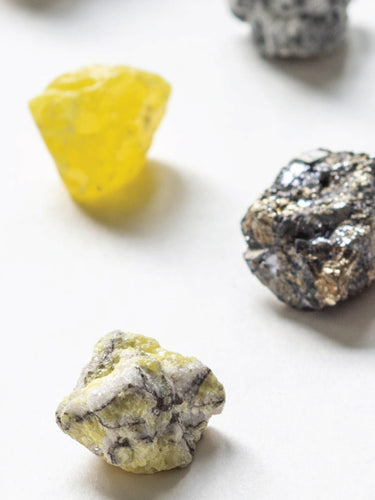
1. Crystal, mineral, rock, gemstone: what's the difference?
These words get used interchangeably, and sorting them out is the first thing that makes you feel like a collector rather than a tourist. Here's the short version:
• Mineral: a naturally occurring, inorganic solid with a specific chemical makeup and an ordered internal structure. Quartz, calcite, and pyrite are minerals.
• Crystal: a solid whose atoms are arranged in a repeating, geometric pattern, which is what gives many minerals their flat faces and sharp points. In everyday use, people say 'crystal' for almost any attractive mineral piece.
• Rock: a mix of one or more minerals stuck together. Granite is a rock made of several minerals; a minera specimen is usually a single species you're collecting on its own.
• Gemstone: a mineral (usually) that's been cut and polished for jewelry. A rough amethyst point is a
specimen; a faceted amethyst in a ring is a gem.
• Specimen: a piece kept whole for display or study rather than cut up. That's what most of this guide is about.
You don't need to be strict about the vocabulary. Just knowing the difference helps you understand what a dealer
is describing and what you're actually buying.
2. Learning to See a Specimen
Two amethyst clusters can sell for wildly different prices, and at first it's a mystery why. Collectors are looking at a handful of things at once. Once you know them, you start seeing them too.
• Species and variety: the mineral itself, and its variety. Amethyst and citrine are both varieties of quartz, for example.
• Locality: where it came from. This matters more than beginners expect. A specimen from a famous or now-closed mine carries a story and a value you can't recreate.
• Crystal habit: how it grew. Points, clusters, cubes, grape-like botryoidal mounds, and geodes are all habits, and some are far rarer for a given mineral than others.
• Aesthetics: color, luster, and how the crystals sit on their host rock. A balanced, eye-catching piece is worth more than a cluttered or dull one, even of the same species.
• Condition: damage is the fastest way a specimen drops in value. A chipped point or a bruised edge matters, so learn to look for it.
You'll also hear specimens sorted by size, which is just a shared shorthand:
• Thumbnail (TN): fits in a one-inch cube. Affordable, easy to store, and a great way to own many species.
• Miniature: roughly one to two inches. The sweet spot for a lot of collectors.
• Small cabinet: about two to three inches.
• Cabinet: three to five inches and up. The showpieces, and usually the priciest.
None is 'better' than another. Thumbnails let you build a wide, affordable collection; cabinet pieces make a statement. Many collectors mix them.
3. A Starter Vocabulary
You'll pick these up quickly, and they make dealer conversations and listings much easier to follow:
• Matrix: the host rock the crystals grew on.
• Termination: the finished point at the end of a crystal. A damaged termination hurts value.
• Druzy: a sparkling carpet of tiny crystals.
• Botryoidal: rounded, grape-like clusters.
• Mohs hardness: a 1 to 10 scratch-resistance scale (talc is 1, diamond is 10). It tells you how tough or delicate a mineral is, which drives how you clean and handle it.
• Luster: how a surface reflects light, from metallic to glassy (vitreous) to pearly or silky.
• Cleavage vs fracture: how a mineral breaks. Some split cleanly along flat planes (cleavage); others break irregularly (fracture). It's why some species chip so easily.
• Associated minerals: the other species a mineral is commonly found with, which often adds interest and value.
4. Choosing What to Collect
A collection feels intentional when there's a thread running through it, and picking a focus also stretches your budget and your shelf space. Some popular ways to collect:
• By species: go wide across many minerals, or deep on one you love, like every variety and locality of fluorite.
• By locality: collect everything from one mine, region, or country.
• By color or look: a whole shelf of blue minerals is a striking, and surprisingly educational, thing to build.
• By form: all geodes, all clusters, all spheres.
• By theme: fluorescent minerals that glow under UV light are a magical rabbit hole of their own.
• Self-collected: pieces you dig yourself, on a club field trip or a fee-dig site, carry the best stories of all.
You can also just buy what you love and let a focus emerge over time. That's how most collections actually start.
5. Making your first purchases
The best advice for a new collector is simple: buy the best piece you can afford in your range, and don't rush.
One specimen that genuinely delights you beats five you settled for.
Where to buy
• Local rock shops and club shows: the friendliest starting point, and you can hold pieces in your hand.
• Gem and mineral shows: the big ones are Tucson (February), Denver (September), Springfield in Massachusetts, and Munich, plus smaller regional shows all year. They're overwhelming and wonderful.
• Reputable online dealers: convenient and often better documented, as long as the seller lists locality and is upfront about any treatment.
• Mineral clubs: not a store, but the fastest way to learn, and members often sell or trade.
What to ask, and what to watch for
A good dealer will happily tell you the species, the locality, whether the piece has been treated or repaired, and
the condition. Vague answers, missing locality, prices that seem too good to be true, or damage hidden by
careful photo angles are all reasons to slow down. You're buying from the person as much as the piece.
6. Real, Treated, or Fake?
This is the part that worries new buyers most, so here's the honest framing. Treatment is common in this hobby, and much of it is perfectly accepted. The problem is never the treatment itself. It's a treatment that isn't disclosed.
There are three buckets:
Natural and untreated
Exactly what it sounds like, and what most collectors ultimately prize. It should still come with an honest locality.
Treated or Enhanced (fine when disclosed)
• Heat: the most common enhancement. Most 'citrine' on the market is heat-treated amethyst, often with a slightly toasted look and a whitish base. That's accepted, as long as it's labeled.
• Irradiation: used to create smoky quartz and blue topaz. Treated pieces are safe to handle and are not radioactive, though the color can fade in strong sunlight.
• Aura crystals: real quartz bonded with a fine metallic coating for that rainbow sheen. Genuine as a product, but it should be sold as 'aura,' not as a natural color, and the coating can wear.
• Dyeing: common with agates and with cheap stone dyed to imitate turquoise. Acceptable only if disclosed.
Outright fakes and fabrications (avoid)
• Glass sold as stone: 'cherry quartz,' goldstone, and opalite are manufactured glass. Fake obsidian and other glass show perfectly round air bubbles under a loupe.
• Lab-grown sold as natural: bright blue chalcanthite is often grown in a lab and sold as a wild specimen, and it dissolves in water. Industrial bismuth's rainbow hopper crystals are man-made.
• Invented names: 'azeztulite' is ordinary quartz with a marketing story attached.
• Fabricated pieces: fake malachite and copper coatings made by soaking other crystals in copper solution, and glass sold as moldavite.
Simple checks you can do
Real minerals feel cool to the touch and take a moment to warm up; glass and resin warm fast. Under a loupe, watch for round air bubbles (glass), perfectly even dye, or adhesive residue. Natural stones have color zoning, inclusions, and small irregularities; flawless uniformity is a warning sign. Above all, buy from dealers who tell you the locality and are upfront about treatment. Honesty from the seller is the best authenticity test there is.
7. Care for your Specimens
A little care keeps a collection beautiful for generations. The main things to know:
• Light: some minerals fade in sunlight, including amethyst, rose quartz, celestite, and some fluorite. Keep light-sensitive pieces out of direct sun.
• Water and salt: a safe rule of thumb is that only hard (roughly Mohs 7 and up), non-porous stones with no iron or copper should ever be rinsed. Selenite is soft gypsum and clouds or crumbles in water, halite dissolves, pyrite rusts, and malachite leaches copper. When in doubt, dust with a soft dry brush instead.
• Handling: many minerals are soft or cleave easily. Pick pieces up by the matrix, not by the crystals or terminations.
• Humidity: keep conditions stable and dry. Pyrite and marcasite can slowly break down in humid air, a problem collectors call pyrite decay.
• Radioactive species: a few minerals such as autunite and torbernite are genuinely radioactive. They're beautiful, but keep them in a case, handle them rarely, and don't display them where you sleep. You'll rarely meet these as a beginner, but it's worth knowing they exist.
8. The Label is Half the Specimen
This is the tip most beginners skip and later wish they hadn't. A mineral without its locality loses much of its meaning and value. The moment a piece comes home, record it: species, locality (as specific as you can get), size, when and where you acquired it, what you paid, any treatment, and any prior collection it came from.
Number your pieces and keep a simple catalog, whether that's a notebook, a spreadsheet, or an app. A well-documented collection is worth more, teaches you more, and is a gift to whoever inherits it.
9. Displaying your Collection
Half the joy is looking at your pieces. Small stands and risers lift specimens to their best angle, and grouping by color, species, or locality makes a shelf feel considered. Good lighting brings minerals alive, just keep light-sensitive species out of direct sun. If you catch the fluorescent-mineral bug, a UV lamp opens up a whole second collection hiding inside your first. One practical note for anyone in earthquake country: a dab of museum putty under a specimen is cheap insurance against a bad day.
10. Joining the Community
The mineral world is unusually generous with knowledge, and plugging in will teach you faster than any single guide. A few places to start:
• Mindat.org: the free, definitive database of minerals and localities. Look up any species or mine and fall down the rabbit hole.
• Local gem and mineral clubs: field trips, expertise, and friendly people who love answering beginner questions.
• Shows: even the small regional ones are a fast education and a great place to handle a lot of material.
• Sourcing and ethics: favor dealers who care about fair sourcing and mine safety, and if you collect in the field, learn the rules first, since public and private land have very different permissions.
Ask questions everywhere. The person who looked a little too long at that museum case is exactly who this
community loves to welcome.
Where to go from here
Start with one piece that gives you the feeling you had at the museum. Learn its species, its locality, and its story, then let curiosity lead. If you'd like a place to begin browsing, our species collections are a good wander, and the finest, rarest pieces live in The Reserve. Whatever you collect, and however fast or slow you go, you're now part of a very old and very welcoming pursuit. If you ever have a question or are chasing something specific, get in touch.
Frequently Asked Questions
What's the difference between a crystal and a mineral?
A mineral is a naturally occurring solid with a specific chemical makeup. A crystal is a solid whose atoms are arranged in a repeating geometric pattern, which is what gives many minerals their faces and points. In casual use, 'crystal' just means an attractive mineral piece.
How do I know if a crystal is real?
Real minerals feel cool and warm up slowly; glass and resin warm quickly. Under a loupe, watch for round air bubbles, perfectly even dye, or glue. Natural stones have color zoning and small irregularities, while flawless uniformity is suspicious. The best test is a dealer who tells you the locality and discloses any treatment.
Is heat-treated citrine fake?
Not fake, but treated. Most citrine on the market is heat-treated amethyst, which is widely accepted as long as the seller discloses it. Natural, untreated citrine also exists and is rarer. The issue is only ever disclosure, not the treatment itself.
How much money do I need to start collecting?
Very little. Thumbnail and miniature specimens let you own genuinely nice examples of many species for modest prices, and you can build a real collection slowly from there. Buy the best piece you can afford in your range rather than many cheap ones.
Can I wash my crystals in water?
Only some. As a rule, only hard, non-porous stones with no iron or copper are safe to rinse. Soft or soluble minerals like selenite and halite are damaged by water, pyrite rusts, and malachite leaches copper. When unsure, dust gently with a soft dry brush.
What's a good mineral for a complete beginner to start with?
Quartz and its varieties, like amethyst and clear quartz, are hard, affordable, easy to care for, and widely available, which makes them a forgiving first purchase while you learn what you love.


